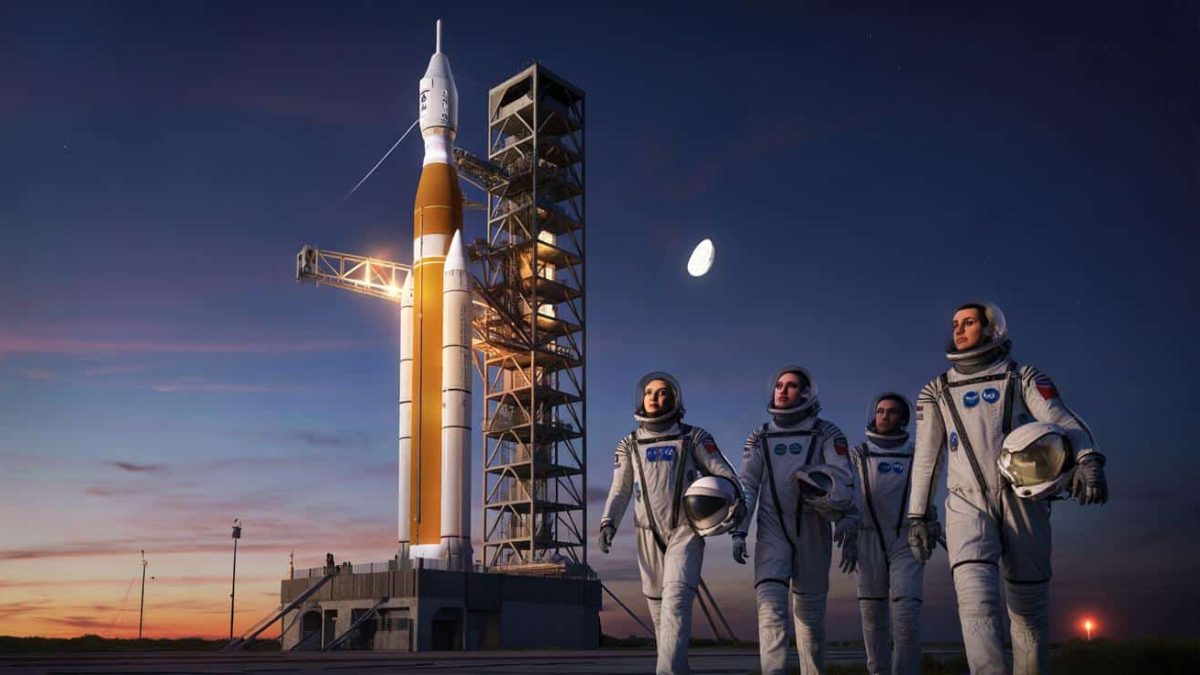
Excitement is building at the Kennedy Space Center in Florida as one of the most powerful rockets of our time has arrived at its legendary launch site. The NASA Artemis II mission is set to make history, marking the first crewed flight around the Moon in over 50 years. This groundbreaking journey will not only showcase the remarkable advancements in space technology but also rekindle the world’s fascination with lunar exploration.
As the massive rocket stands tall on Launch Pad 39B, the anticipation is palpable. The Artemis II mission represents a significant milestone in NASA’s ambitious Artemis program, which aims to establish a sustainable presence on the Moon and use it as a springboard for future deep-space exploration, including the eventual journey to Mars.
This mission is a testament to the unwavering determination and innovative spirit of the space agency, as well as the global community of scientists, engineers, and enthusiasts who have dedicated their efforts to making this dream a reality.
A Colossal Journey: How Artemis II Reached the Launch Pad
The journey of Artemis II to the launch pad has been nothing short of a logistical marvel. The sheer size and complexity of the Space Launch System (SLS) rocket, which stands taller than the Statue of Liberty, have presented unique challenges in its transportation and assembly.
From the manufacturing facilities in Louisiana to the integration and testing sites in Florida, the Artemis II hardware has traversed thousands of miles, navigating the intricate logistics of the space program. Each step of the way, the NASA team has meticulously planned and executed every phase of the process, ensuring the rocket’s safe arrival at the launch pad.
The successful completion of this preparatory phase sets the stage for the next crucial step: the launch itself, where the world will witness the power and precision of the Artemis II mission.
What Makes Artemis II So Remarkable?
Artemis II is a truly remarkable mission for several reasons. Unlike previous crewed lunar missions, this flight will not involve a direct landing on the lunar surface. Instead, the astronauts will embark on a circumnavigation of the Moon, venturing further into deep space than any human has gone since the Apollo era.
The mission will test the capabilities of the Orion spacecraft, the centerpiece of the Artemis program, as it navigates the complex lunar environment. The crew will conduct a range of scientific experiments and observations, providing invaluable data to support future Artemis missions and the long-term goal of establishing a sustainable human presence on the Moon.
Additionally, Artemis II will serve as a critical stepping stone towards the ultimate objective of the Artemis program: sending the first woman and the first person of color to the lunar surface. This milestone will not only inspire a new generation of space explorers but also represent a significant step towards greater diversity and inclusivity in the space industry.
The Significance of the Artemis II Mission
The Artemis II mission holds immense significance for NASA and the global space community. It marks a pivotal moment in the agency’s rejuvenated effort to return humans to the Moon, a goal that has not been achieved since the last Apollo mission in 1972.
This flight will not only demonstrate the capabilities of the Orion spacecraft and the powerful SLS rocket but also pave the way for future Artemis missions that aim to establish a permanent human presence on the lunar surface. The knowledge and experience gained from Artemis II will be crucial in shaping the design and execution of subsequent missions, ultimately leading to the establishment of a sustainable lunar base.
Furthermore, the Artemis program, of which Artemis II is a vital component, represents a renewed global interest in lunar exploration. This mission will reignite public enthusiasm for space travel and inspire a new generation of scientists, engineers, and explorers to push the boundaries of human exploration.
- ➡Nordbalkon und Schattenbeet: Diese 7 Blütenstars bringen Farbe bis in den Herbst
- ➡„Ausgestorben“ seit 6.000 Jahren: Winzige Beuteltiere feiern Comeback in Neuguinea
- ➡Pfingstrosen explodieren in Blütenpracht, wenn diese Nachbarn daneben stehen
- ➡Warum viele Menschen ihre Hautpflegeprodukte in der falschen Reihenfolge benutzen
The Larger Goal: A Lasting Lunar Presence and a Springboard to Mars
The Artemis II mission is not merely a single, isolated event but rather a stepping stone towards a much grander vision. The overarching goal of the Artemis program is to establish a sustained human presence on the Moon, creating a permanent outpost that can serve as a launching pad for future deep-space exploration, including the journey to Mars.
By building a robust infrastructure on the lunar surface, the Artemis program aims to unlock new scientific discoveries, test advanced technologies, and pave the way for long-term human habitation beyond Earth. The lessons learned from Artemis II and subsequent missions will be invaluable in shaping the design and implementation of this ambitious plan.
As the world eagerly watches the Artemis II launch, the implications of this mission extend far beyond the confines of the launch pad. It represents a renewed era of lunar exploration, one that holds the promise of unlocking the mysteries of the Moon and propelling humanity towards a future where the exploration of the Solar System is a common reality.
What’s Happening at Launch Pad 39B
As the Artemis II mission approaches its launch, the teams at the Kennedy Space Center are working tirelessly to ensure the success of this historic flight. The massive SLS rocket, standing tall on Launch Pad 39B, is undergoing a series of final checks and preparations before the anticipated liftoff.
- ➡Warum Parkour laut Sportwissenschaftlern Beweglichkeit, Reaktionsfähigkeit und Körperkontrolle extrem fordert
- ➡Garten-Hack statt Chemie: Warum Spülmittel beim Unkraut killen Trumpf ist
- ➡Psychologie: Was es wirklich bedeutet, wenn du Smalltalk meidest
- ➡Nach Oster-Schock an der Kasse: Mutter verlässt ihren geizigen Mann
In the coming weeks, the launch team will perform a crucial pre-launch test, known as the Wet Dress Rehearsal, which will simulate the entire launch sequence without actually igniting the engines. This meticulous process will allow the team to identify and address any potential issues, ensuring the smooth execution of the actual launch.
As the countdown to launch day ticks away, the world’s attention will be firmly fixed on the Kennedy Space Center, where the next chapter of human lunar exploration is about to unfold.
The Impact of Artemis II on Earth
The significance of the Artemis II mission extends far beyond the boundaries of the launch pad and the lunar orbit. This historic flight holds the potential to inspire and captivate people around the world, reigniting a collective sense of wonder and curiosity about the mysteries of the cosmos.
As the astronauts embark on their journey, their experiences and discoveries will be shared with the global community, sparking conversations, fostering scientific collaborations, and igniting the imaginations of individuals, especially the younger generations who will shape the future of space exploration.
- ➡Glanzfrei bis abends: Diese günstige Matte-Puder sorgt für ruhigen Teint
- ➡Rätselhafter Radioblitz im All: Neues Himmelsobjekt sendet alle 36 Minuten
- ➡Diese kurze Mobilitätsroutine kann laut Sportärzten helfen, Gelenke beweglich und schmerzfrei zu halten
- ➡Nur wenige Menschen hören dieses geheime Donnern im eigenen Kopf
Moreover, the technological advancements and scientific breakthroughs that emerge from the Artemis II mission have the potential to yield tangible benefits for life on Earth. From new materials and manufacturing techniques to advancements in medical research and communication technologies, the ripple effects of this mission could be far-reaching and transformative.
Challenges, Risks, and Open Questions
While the excitement and anticipation surrounding the Artemis II mission are palpable, it is essential to acknowledge the challenges, risks, and open questions that come with such an ambitious endeavor. Space exploration has always been fraught with uncertainty, and the Artemis program is no exception.
One of the primary concerns is the reliability and performance of the SLS rocket and the Orion spacecraft, both of which are still relatively new and untested in crewed deep-space missions. The teams at NASA will need to meticulously monitor and address any potential technical issues that may arise during the flight.
Additionally, the long-term effects of extended exposure to the harsh lunar environment on the health and well-being of the astronauts remain an open question. The Artemis II mission will provide invaluable data to help address these concerns and pave the way for more sustainable and safer deep-space exploration in the future.
| Key Milestones for Artemis II | Timeline |
|---|---|
| Rollout to Launch Pad 39B | March 2023 |
| Wet Dress Rehearsal | April 2023 |
| Launch Window Opens | November 2024 |
| Lunar Flyby | December 2024 |
| Splashdown | December 2024 |
| Artemis II Mission Overview | Key Facts |
|---|---|
| Crew | 4 astronauts (to be announced) |
| Duration | Approximately 10-14 days |
| Orbit | Lunar Flyby (no landing) |
| Objectives |
|
“Artemis II is a critical step in NASA’s plan to establish a sustainable human presence on the Moon. This mission will not only test the capabilities of our spacecraft but also inspire a new generation of explorers to push the boundaries of what is possible.”
– Dr. Thomas Zurbuchen, NASA Associate Administrator for Science Mission Directorate
Also Read
“The Artemis II mission represents a significant milestone in humanity’s exploration of the Moon. The data and insights gained from this flight will be invaluable in shaping the future of lunar exploration and our journey towards Mars.”
– Dr. Sarah Al Amiri, Chairwoman of the UAE Space Agency
“Artemis II is not just about sending astronauts around the Moon; it’s about paving the way for a sustainable human presence on the lunar surface. This mission will lay the groundwork for the next phase of lunar exploration and the eventual journey to Mars.”
– Dr. Kathy Lueders, NASA Associate Administrator for Space Operations
As the world eagerly awaits the launch of Artemis II, the anticipation and excitement are palpable. This mission represents a significant step forward in humanity’s exploration of the cosmos, unlocking new frontiers and inspiring generations to come.
The journey of Artemis II is not just about reaching the Moon; it’s about pushing the boundaries of human achievement, fostering international collaboration, and igniting the imagination of people across the globe. As the astronauts embark on their historic voyage, they carry with them the dreams and aspirations of all those who have dared to look skyward and wonder what lies beyond.
The success of Artemis II will undoubtedly pave the way for even more ambitious endeavors in the years to come, as the world collectively works towards the establishment of a sustainable human presence on the lunar surface and the eventual journey to Mars. The future of space exploration has never been brighter, and the Artemis II mission is a testament to the boundless potential of human ingenuity and exploration.
When is the Artemis II launch scheduled?
The launch window for the Artemis II mission is currently targeted for November 2024, with the actual lunar flyby and splashdown expected to take place in December 2024.
- ➡Diese 10 Turbo-Stauden lassen deinen Garten in einem Sommer explodieren
- ➡Nur bis 10. März: Dieser Schnitt-Trick macht vier Obstbäume zur Erntemaschine
- ➡Schock beim Knabbern: Kundin findet schwarze Chips in San‑Carlo-Tüte
- ➡Nivea-Creme nur auf einer Gesichtshälfte: So krass fiel der Unterschied nach 7 Tagen aus
How long will the Artemis II mission last?
The Artemis II mission is expected to last approximately 10-14 days, with the astronauts spending several days in lunar orbit before returning to Earth.
Who will be the crew for Artemis II?
The crew for Artemis II has not been officially announced yet. NASA is expected to reveal the four astronauts selected for this historic mission in the coming months.
What are the main objectives of the Artemis II mission?
The primary objectives of Artemis II include testing the capabilities of the Orion spacecraft, conducting scientific experiments and observations in the lunar environment, and paving the way for future Artemis missions that will establish a sustainable human presence on the Moon.
How will the Artemis II mission contribute to the Artemis program’s long-term goals?
Artemis II is a crucial stepping stone towards the Artemis program’s overarching goal of establishing a permanent human presence on the lunar surface. The lessons learned from this mission will inform the design and execution of subsequent Artemis missions, ultimately leading to the first crewed landing on the Moon since the Apollo era.
What are the key milestones leading up to the Artemis II launch?
The key milestones for the Artemis II mission include the rollout of the SLS rocket to Launch Pad 39B in March 2023, the Wet Dress Rehearsal in April 2023, and the opening of the launch window in November 2024.
How can the public stay informed about the Artemis II mission?
NASA will be providing regular updates and live coverage of the Artemis II mission on its official website, social media channels, and through various media outlets. The public can also follow the progress of the mission and get involved in the excitement through educational resources and community events.
What are the potential challenges and risks associated with the Artemis II mission?
Some of the key challenges and risks include the reliability and performance of the SLS rocket and Orion spacecraft, as well as the long-term effects of deep-space radiation and the harsh lunar environment on the astronauts. NASA is carefully monitoring and addressing these concerns to ensure the success and safety of the Artemis II mission.