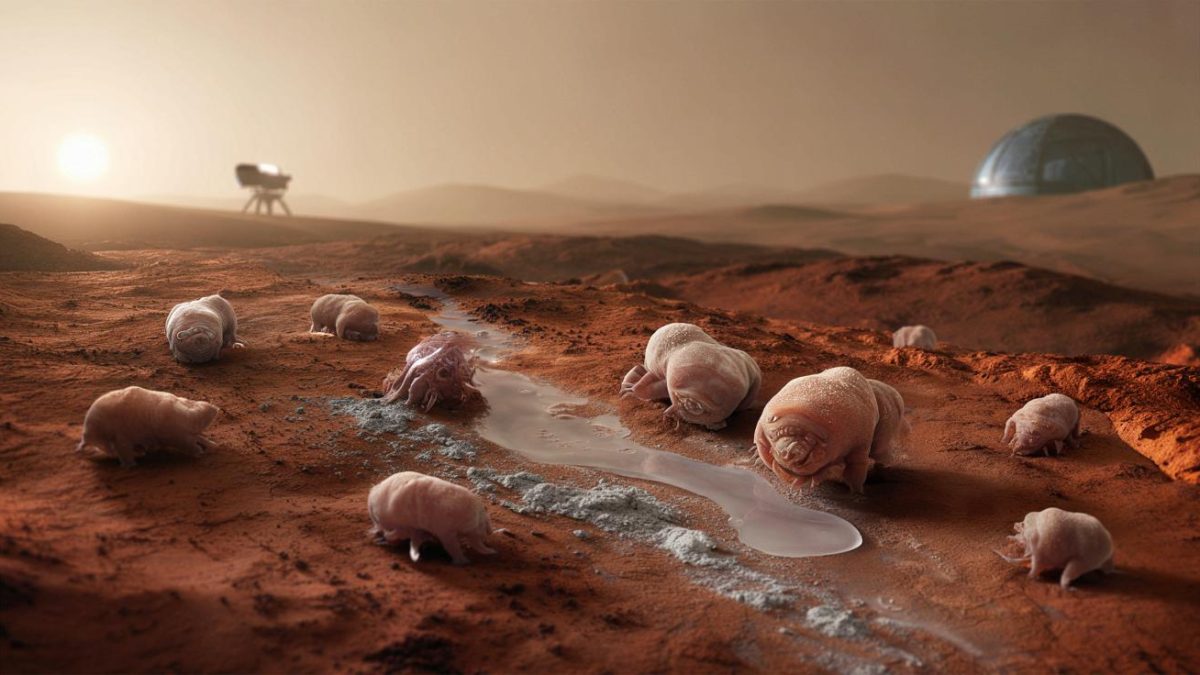
In the harsh and unforgiving landscape of the Martian surface, where the elements conspire to crush even the sturdiest of life forms, a tiny creature has emerged as a beacon of resilience. Bärtierchen, or tardigrades, are microscopic invertebrates that have captured the imagination of scientists and the public alike with their remarkable ability to withstand the most extreme conditions imaginable.
A recent study conducted by a team of researchers has delved deeper into the capabilities of these remarkable creatures, subjecting them to the harsh simulated environment of the Martian soil. The results, as it turns out, are both surprising and enlightening, shedding light on the potential for life to thrive in the most inhospitable corners of our solar system.
Unraveling the Secrets of Tardigrade Resilience
Tardigrades, often referred to as “water bears,” are renowned for their ability to survive in extreme environments, from the scorching deserts of Africa to the frozen tundras of Antarctica. Their unique physiology, which includes the ability to enter a state of suspended animation known as cryptobiosis, allows them to withstand intense dehydration, extreme temperatures, and even the vacuum of space.
This remarkable adaptability has made them the subject of intense scientific scrutiny, as researchers seek to understand the mechanisms that enable these tiny creatures to survive in conditions that would quickly overwhelm most other life forms. By delving into the secrets of tardigrade resilience, scientists hope to unlock insights that could one day aid in the exploration of other planetary bodies, including the harsh surface of Mars.
The latest study, conducted by a team of researchers from the University of Arkansas, has taken this exploration to the next level, subjecting tardigrades to an even more extreme test: the simulated Martian soil.
Replicating the Martian Environment in the Lab
The researchers responsible for this groundbreaking study faced a significant challenge: how to accurately recreate the harsh conditions of the Martian surface in a controlled laboratory setting. After all, the Martian environment is a far cry from the comfortable confines of Earth, with its extreme temperatures, low atmospheric pressure, and a soil composition that is dramatically different from anything found on our own planet.
To meet this challenge, the team meticulously crafted an artificial Martian soil, blending together a unique mixture of minerals and compounds that mimic the composition of the Martian regolith. This carefully curated substrate was then placed in a specially designed chamber, where the temperature, pressure, and other environmental factors could be precisely controlled to match the conditions found on the Martian surface.
With this meticulously crafted Martian ecosystem in place, the researchers then introduced their subjects: a population of tardigrades, carefully selected and prepared for the ultimate test of their resilience.
The Shocking Revelation: Tardigrades Go into Survival Mode
As the tardigrades were placed into the simulated Martian soil, the researchers held their collective breath, eager to see how these microscopic marvels would respond to the extreme environment. What they observed, however, was both surprising and deeply concerning.
Almost immediately, the tardigrades entered a state of cryptobiosis, a last-ditch survival mechanism that allows them to essentially shut down their metabolism and enter a state of suspended animation. This response, while a testament to the creatures’ resilience, also raised a troubling question: could tardigrades, and potentially other forms of life, truly thrive in the harsh Martian environment, or were they simply clinging to survival?
The implications of this finding are far-reaching, as it challenges the notion that life on Mars could simply take root and flourish, even in the most resilient of forms. Instead, it suggests that any potential Martian lifeforms would be in a constant battle for survival, constantly teetering on the edge of extinction as they struggle to adapt to the planet’s unforgiving conditions.
Protecting Mars and Easing the Burden of Spaceflight
The discovery that even the remarkably hardy tardigrades struggle to cope with the Martian environment has far-reaching implications for the future of space exploration. For one, it underscores the need to take extreme precautions when it comes to planetary protection, ensuring that any potential contamination from Earth-based lifeforms does not jeopardize the delicate balance of the Martian ecosystem.
At the same time, this research also offers a glimmer of hope for the future of human exploration on Mars. By better understanding the limitations of even the most resilient forms of life, scientists can develop more effective strategies for shielding and protecting future human settlers from the harsh Martian environment.
Moreover, the insights gained from this study could also help to ease the logistical challenges of long-term space travel, as researchers work to develop more robust and resilient systems for supporting life in the harsh conditions of deep space.
Unlocking the Potential of Martian Soil
While the initial findings of this study may seem discouraging, they also open up new avenues of exploration and discovery. By understanding the limits of what even the most resilient lifeforms can withstand on Mars, scientists can now turn their attention to the question of how to make the Martian environment more hospitable for potential human colonization.
One promising avenue of research involves the potential of Martian soil itself. By exploring ways to chemically or biologically modify the Martian regolith, researchers may be able to create a more fertile and life-sustaining substrate, paving the way for the cultivation of crops and the establishment of self-sustaining ecosystems on the Martian surface.
As the exploration of Mars continues to capture the imagination of the global scientific community, the insights gained from this study on tardigrades will undoubtedly play a crucial role in shaping the future of space exploration and the quest to uncover the secrets of the Red Planet.
What the Tardigrade Experiment Reveals About the Chances of Life on Mars
The findings of this study on tardigrades in simulated Martian soil offer important insights into the potential for life to exist on the Red Planet. While the remarkable resilience of these microscopic creatures had long been touted as evidence of their ability to thrive in the harshest of environments, the fact that they enter a state of cryptobiosis when exposed to Martian soil suggests that the planet’s surface may not be as hospitable as previously thought.
This revelation challenges the notion that Mars could simply be a “second Earth,” capable of supporting a diverse array of lifeforms. Instead, it suggests that any potential Martian lifeforms would be in a constant struggle for survival, constantly adapting to the planet’s unforgiving conditions in order to eke out an existence.
At the same time, the study also highlights the importance of continuing to explore and investigate the Martian environment, as there may still be opportunities for life to flourish in more hospitable niches or through the development of innovative adaptations. By pushing the boundaries of what we know about the limits of life, this research opens up new avenues of inquiry and pushes us closer to unraveling the mysteries of the Red Planet.
- ➡Geheimtipp in Kalifornien: Dieser beeindruckende Mammutwald übertrifft sogar den Sequoia Nationalpark
- ➡Einfacher Alltagstrick: So können Sie Alzheimer-Jahre hinauszögern
- ➡Wenn die Hecke den Nachbarn krank macht: Das droht Grundstücksbesitzern
- ➡Steuertrick 2026: So lassen sich über 300.000 Euro steuerfrei verschenken
Lessons for Earthlings from the Tardigrade Experiment
While the implications of this study on tardigrades and the Martian environment may seem far-removed from the everyday concerns of Earthlings, there are important lessons to be gleaned that can be applied closer to home.
For one, the resilience and adaptability of the tardigrade serves as a powerful reminder of the incredible diversity and resourcefulness of life on our own planet. By understanding the capabilities of these microscopic creatures, we gain a deeper appreciation for the fragility and adaptability of all living things, and the importance of preserving the delicate balance of our own ecosystems.
Moreover, the insights gained from this research on the limitations of even the hardiest lifeforms in extreme environments can serve as a cautionary tale about the potential consequences of environmental degradation and climate change on Earth. Just as the Martian surface may prove inhospitable to all but the most resilient of creatures, our own planet faces the looming threat of environmental collapse, with the potential to push even the most adaptable species to the brink of extinction.
| Key Findings from the Tardigrade Experiment | Implications for Mars Exploration |
|---|---|
| Tardigrades entered a state of cryptobiosis when exposed to simulated Martian soil | Suggests that even the most resilient lifeforms may struggle to thrive on the Martian surface |
| Tardigrades were unable to actively metabolize and function in the Martian environment | Challenges the notion that Mars could simply support diverse lifeforms, highlighting the need for more robust planetary protection measures |
| The study underscores the limitations of even the hardiest known lifeforms in extreme environments | Provides important insights for developing more effective strategies for shielding and protecting future human settlers on Mars |
“This study really drives home the fact that we can’t just assume that life will automatically thrive on Mars, even in the most resilient of forms. It’s a sobering reminder that the Martian environment is truly unforgiving, and that we have a lot of work to do if we want to establish a sustainable human presence there.”
– Dr. Samantha Gallagher, Planetary Scientist, University of Arizona
“The findings from this tardigrade experiment are a significant step forward in our understanding of the limits of life in extreme environments. While it’s disappointing to see that even these remarkable creatures struggle to cope with the Martian conditions, it also highlights the importance of continuing to explore and investigate the potential for life on other planets.”
– Dr. James Huang, Astrobiologist, NASA Ames Research Center
“This research underscores the critical importance of planetary protection and the need to take extreme precautions when it comes to the potential contamination of other worlds. By better understanding the limitations of even the hardiest lifeforms, we can develop more effective strategies for safeguarding the delicate Martian ecosystem and ensuring the success of future human exploration.”
– Dr. Emily Chen, Policy Advisor, International Planetary Protection Agency
As the exploration of Mars continues to captivate the global scientific community, the insights gained from this study on tardigrades will undoubtedly play a crucial role in shaping the future of space exploration and the quest to uncover the secrets of the Red Planet.
What makes tardigrades so resilient?
Tardigrades, also known as “water bears,” are renowned for their incredible ability to withstand extreme environmental conditions. This is due to their unique physiology, which includes the ability to enter a state of suspended animation called cryptobiosis. During this state, they can survive dehydration, extreme temperatures, and even the vacuum of space.
How did researchers recreate the Martian environment in the lab?
To simulate the Martian environment, researchers carefully crafted an artificial Martian soil by blending together a unique mixture of minerals and compounds that mimic the composition of the Martian regolith. This substrate was then placed in a specially designed chamber where the temperature, pressure, and other environmental factors could be precisely controlled to match the conditions found on the Martian surface.
What happened when the tardigrades were exposed to the simulated Martian soil?
When the tardigrades were placed into the simulated Martian soil, they almost immediately entered a state of cryptobiosis, a last-ditch survival mechanism that allows them to shut down their metabolism and enter a state of suspended animation. This response, while a testament to the creatures’ resilience, also raised concerns about their ability to truly thrive in the harsh Martian environment.
How does this study challenge the idea of Mars as a “second Earth”?
The finding that even the remarkably hardy tardigrades struggle to cope with the Martian environment challenges the notion that Mars could simply be a “second Earth,” capable of supporting a diverse array of lifeforms. Instead, it suggests that any potential Martian lifeforms would be in a constant battle for survival, constantly adapting to the planet’s unforgiving conditions.
What are the implications for future Mars exploration and human settlement?
The insights gained from this study on the limitations of even the most resilient lifeforms in the Martian environment can help inform the development of more effective strategies for shielding and protecting future human settlers from the harsh conditions of the Red Planet. It also underscores the importance of continued research and exploration to better understand the potential for life on Mars.
- ➡Wenn Menschen im Alter stur werden: 7 Warnsignale, die Angehörige kennen sollten
- ➡Luc Alphand und seine Patchwork-Familie: Warum seine Kinder verschiedene Pässe haben
- ➡10. März 2026: Diese 4 Sternzeichen erleben einen unglaublichen Glücksschub
- ➡Warum gesehene Schmerzen weich machen – und ignorierte hart
How can the lessons from this study be applied to environmental protection on Earth?
The resilience and adaptability of the tardigrade, as well as the limitations of even the hardiest lifeforms in extreme environments, serve as a powerful reminder of the fragility and importance of preserving the delicate balance of our own ecosystems on Earth. This research can help inspire a greater appreciation for the need to address environmental degradation and climate change.
What are the next steps for researchers investigating the potential for life on Mars?
Moving forward, researchers will likely focus on exploring more hospitable niches on the Martian surface, as well as investigating the potential for life to thrive through the development of innovative adaptations. Additionally, there will be a continued emphasis on understanding the limits of life in extreme environments and developing more effective planetary protection measures.
How can the findings from this study help improve the logistics of long-term space travel?
The insights gained from this study on the limitations of even the most resilient lifeforms in the harsh conditions of space can help researchers develop more robust and resilient systems for supporting life during long-term space missions. This could include the development of more advanced life support systems, as well as the exploration of alternative sources of food and resources for space travelers.