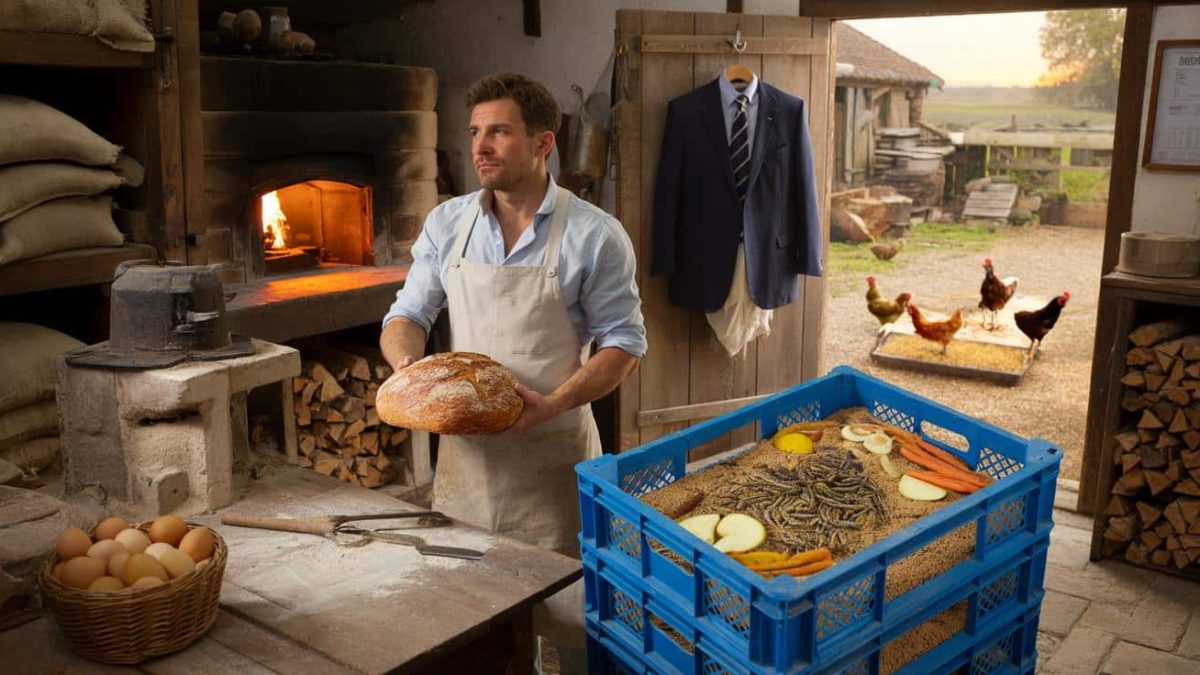
Fabien Billette, a former banker, has traded in his suit and tie for an apron and a wood-fired oven. In the small town of Bignicourt-sur-Saulx, he now runs his own bakery, crafting sourdough breads and organic brioche, all baked to perfection in his artisanal setup.
But Billette’s journey goes beyond the delicious aromas wafting from his bakery. He’s found an innovative solution to a pressing problem: food waste. By incorporating mealworms into his production process, he’s not only tackling his own waste but also creating a sustainable source of protein for local farmers.
It’s a story of reinvention, environmental responsibility, and the power of thinking outside the box – a testament to how one person’s determination can create a ripple effect that benefits an entire community.
From Banker to Baker: Billette’s Unlikely Transition
Fabien Billette spent years working in the financial sector, but a growing disillusionment with the corporate world led him to seek a more fulfilling path. “I felt disconnected from the tangible impact of my work,” he recalls. “I wanted to create something with my own hands, something that would truly benefit my community.”
In 2020, Billette made the bold decision to leave his banking career behind and pursue his passion for baking. He invested in a small bakery, outfitting it with a wood-fired oven and embarking on a journey to master the art of artisanal bread-making.
The transition was not without its challenges, but Billette’s determination and creativity proved to be his greatest assets. “It was a steep learning curve, but I was driven by a deep sense of purpose,” he says. “I knew that this path would allow me to connect with my community in a more meaningful way.”
Turning Waste into Wealth: Mealworms to the Rescue
As Billette’s bakery flourished, he faced a common challenge: managing the waste produced by his operation. From discarded bread crusts to leftover grain, the bakery was generating significant amounts of organic material that needed to be disposed of properly.
But Billette saw an opportunity where others might have seen only a problem. He began researching alternative uses for his bakery’s waste, and that’s when he stumbled upon the idea of mealworms.
- ➡Wenn Menschen im Alter stur werden: 7 Warnsignale, die Angehörige kennen sollten
- ➡Ein Trick mit 24 Stunden, der deine spontanen Ausgaben stoppt
- ➡Französische Traumküste vor dem Kipppunkt: In dieser Stadt wird der Alltag bis 2030 zum Risiko
- ➡Neue Masche an der Zapfsäule: So zocken Trickbetrüger Autofahrer ab
Mealworms, the larvae of the darkling beetle, are not only a nutritious food source for humans but also a valuable feed for livestock. Billette started experimenting with incorporating mealworms into his production process, using them to convert his bakery’s waste into a high-protein, nutrient-rich feed for local farmers.
Protein Powerhouse: Mealworms as Animal Feed
The mealworms have proven to be a game-changer for Billette’s bakery. Not only do they help him reduce his waste, but they also provide a valuable source of protein for the local farming community.
Farmers in the area have enthusiastically embraced Billette’s mealworm initiative, incorporating the nutrient-dense feed into their livestock’s diets. “The mealworms have been a real boost for our chickens and pigs,” says local farmer Émilie Dupont. “They’ve helped improve the overall health and productivity of our animals.”
Beyond the immediate benefits to the farmers, Billette’s mealworm project also has broader implications for the region’s food system. By closing the loop on waste and creating a sustainable source of animal feed, he is contributing to a more circular and resilient local economy.
Regulatory Landscape and Health Considerations
Navigating the legal and regulatory framework surrounding the use of mealworms in food production has been a critical aspect of Billette’s endeavor. He has worked closely with local authorities to ensure that his practices comply with all relevant health and safety standards.
The use of mealworms as a food source, both for humans and animals, is an emerging field with evolving regulations. Billette has stayed abreast of the latest developments, actively participating in industry discussions and collaborating with policymakers to ensure that his operations are not only innovative but also responsible and transparent.
From a health perspective, the mealworms used in Billette’s bakery have been carefully vetted and found to be a safe and nutritious addition to the local food system. “Mealworms are a rich source of protein, vitamins, and minerals,” explains nutritionist Sylvie Rousseau. “When incorporated into a balanced diet, they can provide significant health benefits for both humans and animals.”
Beyond the Bakery: Scaling the Mealworm Solution
Billette’s mealworm initiative has garnered attention far beyond the boundaries of his own bakery. Recognizing the potential for this approach to address broader food waste and sustainability challenges, he has been actively engaging with other local businesses and organizations.
- ➡Geniale Muffin-Idee von Starpatissière: So werden herzhafte Muffins außen knusprig, innen fluffig
- ➡Gratulacje z okazji zaręczyn: oficjalne, pomysłowe i z humorem
- ➡Forscher finden 600 Jahre alte Weintraubenkerne in Klo-Grube – Pinot Noir DNA sorgt für Überraschung
- ➡Ständig müde? Dieses lila Knollen-Gemüse brachte mir neue Energie
Through workshops, collaborative projects, and knowledge-sharing sessions, Billette is working to inspire and empower others to adopt similar waste-to-value strategies. “By demonstrating the viability and benefits of this model, we can create a ripple effect that has the potential to transform our regional food system,” he says.
The ultimate goal is to establish a network of interconnected farms and businesses that collectively tackle food waste and promote sustainable, circular practices. Billette envisions a future where mealworms become a ubiquitous part of the local agricultural landscape, contributing to a more resilient and environmentally conscious food ecosystem.
A Bakery as a Microcosm of Sustainability
Billette’s bakery has become more than just a place to buy artisanal bread. It has evolved into a small-scale model of sustainable practices, where waste is transformed into valuable resources and where the boundaries between production and consumption are blurred.
From the wood-fired oven that reduces energy consumption to the mealworm-based feed that nourishes local livestock, every aspect of Billette’s bakery is designed to minimize environmental impact and foster a more circular economy.
As visitors step into the bakery, they are not just greeted by the aroma of freshly baked bread but also by a tangible sense of purpose and innovation. Billette’s story serves as a testament to the power of individual action and the transformative potential of rethinking conventional systems.
Key Terms Explained
| Term | Explanation |
|---|---|
| Mealworms | The larvae of the darkling beetle, known for their high protein content and nutritional value. |
| Circular Economy | An economic model that focuses on minimizing waste and reusing resources, rather than the traditional linear “take-make-waste” approach. |
| Artisanal Bread | Bread made using traditional methods, often with a focus on quality ingredients and handcrafted techniques. |
| Sourdough | A type of bread made using a fermented dough starter, which gives it a distinctive tangy flavor and chewy texture. |
Risks and Opportunities
Billette’s mealworm-based solution is not without its challenges. Navigating the evolving regulatory landscape and ensuring the continued health and safety of his products will require ongoing vigilance and collaboration with authorities.
Additionally, scaling up the mealworm initiative to reach a wider audience will require significant investment, both in terms of infrastructure and education. Billette recognizes that the long-term success of his model will depend on its ability to be replicated and adopted by other businesses and farms in the region.
However, the potential benefits of Billette’s approach are substantial. By demonstrating the viability of converting food waste into valuable resources, he is paving the way for a more sustainable and resilient local food system. His story serves as a powerful inspiration for others who seek to find innovative solutions to pressing environmental and economic challenges.
What Other Businesses Can Learn
Billette’s journey from banker to baker-turned-mealworm-pioneer offers valuable lessons for businesses and entrepreneurs across various sectors. His story highlights the importance of creativity, adaptability, and a willingness to challenge conventional thinking.
By identifying and addressing a specific problem within his own operations, Billette has not only found a solution but also created a new revenue stream and a positive impact on his community. This approach can be applied to a wide range of industries, encouraging businesses to look inward, identify their own waste streams, and explore innovative ways to transform them into valuable assets.
Furthermore, Billette’s emphasis on collaboration and knowledge-sharing serves as a model for how businesses can work together to create systemic change. By engaging with local partners and fostering a network of like-minded individuals, he is demonstrating the power of collective action in driving sustainability and innovation.
- ➡Warum Sie Spatzen im Garten nicht vertreiben sollten
- ➡Mit Schnittlauch gegen Schädlinge: 13 Pflanzpartner, die dein Beet retten
- ➡IKEA verpasst Kult-Regal BILLY einen radikalen Look in Kobaltblau
- ➡Diese Morgenroutine aus fünf einfachen Bewegungen hilft Menschen über 65, ihre Gelenke beweglich zu halten
FAQ
What are the main benefits of Billette’s mealworm initiative?
The main benefits of Billette’s mealworm initiative include reducing food waste, creating a sustainable source of animal feed, and contributing to a more circular local economy.
How does Billette’s bakery comply with health and safety regulations?
Billette has worked closely with local authorities to ensure that his use of mealworms in food production meets all relevant health and safety standards. He actively participates in industry discussions and collaborates with policymakers to ensure his operations are responsible and transparent.
Can other businesses replicate Billette’s mealworm solution?
Yes, Billette’s mealworm initiative can be replicated by other businesses, particularly those in the food production and agricultural sectors. He is actively working to share his knowledge and inspire others to adopt similar waste-to-value strategies.
How does Billette’s bakery contribute to the local community?
Billette’s bakery not only provides fresh, artisanal bread to the community but also generates a sustainable source of animal feed for local farmers. This helps to strengthen the local food system and promote a more circular economy.
- ➡Pfingstrosen explodieren in Blütenpracht, wenn diese Nachbarn daneben stehen
- ➡Jetzt pflanzen, jahrelang ernten: 7 Kräuter, die fast von selbst wachsen
- ➡Frühling im Garten: Warum Sie diese 3 „Unkräuter“ lieber stehen lassen sollten
- ➡Legendäres Internetkabel aus dem Atlantik gezogen: Wie TAT‑8 Geschichte schrieb
What are the long-term goals of Billette’s mealworm project?
Billette’s long-term goal is to establish a network of interconnected farms and businesses that collectively tackle food waste and promote sustainable, circular practices. He aims to inspire and empower others to adopt similar waste-to-value strategies, ultimately transforming the regional food system.
How does Billette’s bakery reduce its environmental impact?
Billette’s bakery incorporates various sustainable practices, such as the use of a wood-fired oven and the conversion of waste into animal feed through the mealworm initiative. These measures help to reduce the bakery’s overall environmental impact.
What are the key challenges Billette has faced in implementing his mealworm solution?
The main challenges Billette has faced include navigating the evolving regulatory landscape, ensuring the continued health and safety of his products, and scaling up the mealworm initiative to reach a wider audience. Overcoming these challenges requires ongoing collaboration with authorities and significant investment in infrastructure and education.
How can other businesses learn from Billette’s experience?
Billette’s story highlights the importance of creativity, adaptability, and a willingness to challenge conventional thinking. Other businesses can learn from his approach of identifying and addressing specific problems within their operations, and exploring innovative ways to transform waste into valuable assets.
- ➡Blutige Geheimnisse aus der Felsensiedlung: Forscher entschlüsseln mittelalterliches Höhlendorf in Spanien
- ➡Nach 26 Jahren: Spieler startet erstmals Pokémon Gelb – und erlebt einen völlig verrückten Bug
- ➡Garten-Fehler mit Folgen: Diese Gewohnheit kann 750 Euro kosten
- ➡Warum unerwartete Freizeit sich länger anfühlt, als sie wirklich ist