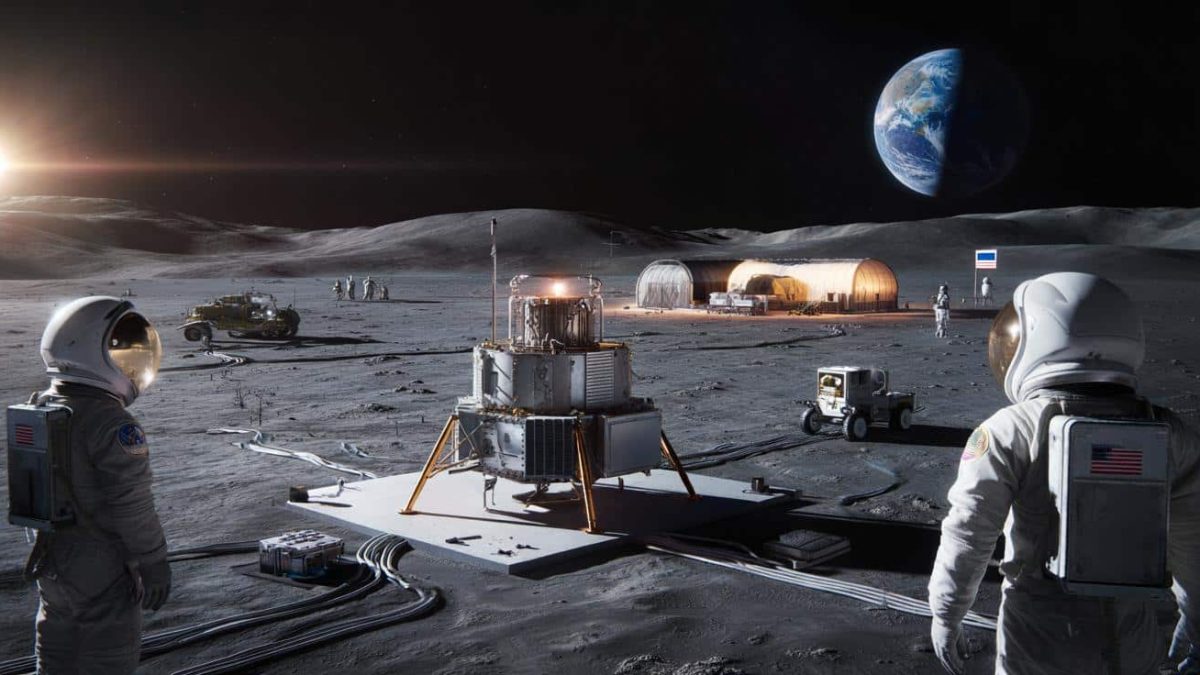
The lunar surface is about to witness a groundbreaking transformation, as the United States sets its sights on establishing a nuclear reactor there by 2030. This ambitious project, a collaboration between NASA and the Department of Energy, is poised to revolutionize energy generation and storage on the moon, paving the way for a sustainable future in space exploration.
The decision to pursue this nuclear-powered approach stems from the limitations of solar energy on the lunar surface. While sunlight is abundant, the lack of a consistent power supply during the long lunar nights poses a significant challenge. This is where the proposed nuclear reactor comes into play, offering a reliable and efficient source of energy that can keep the lights on and the life-support systems running, even in the darkest hours of the moon’s cycle.
The plan, dubbed “Fission Surface Power,” envisions a compact, lightweight nuclear reactor that can be transported to the moon and assembled on-site. Unlike traditional terrestrial nuclear plants, this lunar version is designed to be self-sustaining, with minimal maintenance requirements and the ability to operate autonomously for extended periods.
Powering the Artemis Mission and Beyond
This nuclear energy initiative is closely tied to the Artemis program, NASA’s ambitious plan to return humans to the moon by the end of this decade. The Artemis mission aims to establish a sustainable human presence on the lunar surface, and a reliable power source is essential to achieving this goal.
By harnessing the power of nuclear fission, the Fission Surface Power project will provide the necessary electricity to support a range of critical activities, from life support systems and habitats to scientific research and resource extraction. This reliable energy supply will also enable the development of more advanced technologies, such as in-situ resource utilization, which could unlock new avenues for lunar exploration and resource exploitation.
Moreover, the success of this nuclear reactor project could have far-reaching implications for future space exploration. If proven effective on the moon, the technology could be adapted and scaled for use on other celestial bodies, paving the way for human outposts on Mars or even beyond.
Assembling the Dream Team
The Fission Surface Power project brings together a diverse team of experts from various fields, including nuclear engineering, aerospace, and planetary science. NASA and the Department of Energy have tapped into their vast resources and expertise, collaborating with private companies, research institutions, and international partners to ensure the success of this ambitious endeavor.
Among the key players involved are Lockheed Martin, which is responsible for the reactor’s design and development, and the Idaho National Laboratory, a leading nuclear research facility that will provide critical technical support. Additionally, the project has garnered interest from international space agencies, with the European Space Agency and the Japanese Aerospace Exploration Agency expressing interest in potential collaborations.
- ➡Diese 5 Menschentypen rauben dir auf Dauer deine seelische Gesundheit
- ➡Neue Studie: So holen Bauern den verlorenen Nährstoffgehalt aus Gemüse zurück
- ➡Diese Haarfarbe lässt Frauen ab 50 sofort frischer und strahlender wirken
- ➡Geheimes Zeichen auf zwei Rädern: Warum Biker plötzlich das Bein rausstrecken
The collaboration of these diverse stakeholders, each bringing their unique strengths and perspectives, is crucial to overcoming the technical and logistical challenges inherent in establishing a nuclear reactor on the lunar surface.
Navigating the Geopolitical Landscape
The development of a nuclear reactor on the moon carries significant geopolitical implications, as space exploration has long been a arena of international competition and cooperation. The Fission Surface Power project is no exception, as it has the potential to shift the balance of power and influence in the realm of space technology and resource utilization.
With the United States leading the charge, this initiative is likely to be viewed as a strategic move to assert its technological superiority and secure a dominant position in the emerging lunar economy. However, the project’s success could also pave the way for greater international collaboration, as other space-faring nations may seek to participate in the development and potential benefits of this groundbreaking technology.
Navigating the geopolitical landscape will be a delicate task, requiring diplomacy, transparency, and a commitment to the peaceful exploration and utilization of space resources. The Fission Surface Power project will undoubtedly become a focal point for discussions and negotiations among global space powers, with implications that extend far beyond the confines of the moon.
- ➡Neue Studie bricht mit Alters-Mythos: Viele werden im Alter fitter
- ➡Dieser Turbo-Baum wächst 2 Meter pro Jahr und macht Ihren Garten in drei Jahren komplett blickdicht
- ➡Nie wirklich Feierabend: 10 unsichtbare Regeln, die Perfektionisten nicht abschalten lassen
- ➡Winzlinge im Härtetest: Was Bärtierchen auf Mars-Boden wirklich aushalten
Addressing the Risks of Lunar Nuclear Power
The prospect of a nuclear reactor on the moon naturally raises concerns about safety and environmental impact. The Fission Surface Power team is acutely aware of these issues and has put in place comprehensive measures to mitigate the risks associated with nuclear technology in the space environment.
One of the key design features of the lunar reactor is its inherent safety mechanisms, including multiple redundancies and fail-safe systems to prevent the release of radioactive materials. Additionally, the reactor is designed to be highly resilient, capable of withstanding the rigors of launch, landing, and the harsh lunar environment without compromising its integrity.
Furthermore, the project’s planners have worked closely with regulatory agencies and international bodies to ensure that the lunar nuclear reactor adheres to the highest safety standards and environmental protocols. The goal is to establish a precedent for responsible and sustainable nuclear power generation in space, paving the way for future advancements in this field.
Powering a New Era of Lunar Exploration
The establishment of a nuclear reactor on the moon represents a significant milestone in the history of space exploration. This ambitious project not only addresses the limitations of solar power on the lunar surface but also opens up new possibilities for a sustained human presence on the moon and beyond.
- ➡Wohntrends 2025: So holst du dir mit SHEIN japandi-Harmonie nach Hause
- ➡Geniale Küchen-Trickküche: So garen Gemüse & Fisch ganz ohne Wasser und Fett
- ➡Nie mehr Unkraut im Kies: Mit diesem Profi-Trick bleibt der Garten dauerhaft sauber
- ➡Gefälschte Online-Liebe: Wie Romance Scams selbst clevere Menschen ruinieren
By providing a reliable and abundant source of energy, the Fission Surface Power project will enable a range of technological and scientific advancements, from advanced life-support systems and in-situ resource utilization to the establishment of permanent lunar outposts and the exploration of more distant celestial bodies.
As the United States and its international partners work towards this goal, the world watches with anticipation, eager to witness the dawn of a new era of lunar exploration, powered by the transformative potential of nuclear energy.
| Key Milestones of the Fission Surface Power Project | Timeline |
|---|---|
| Concept Development and Feasibility Studies | 2020 – 2022 |
| Reactor Design and Prototyping | 2022 – 2025 |
| Ground Testing and Validation | 2025 – 2028 |
| Lunar Deployment and Operational Demonstration | 2028 – 2030 |
“This nuclear reactor project on the moon is a game-changer for space exploration. It will provide the reliable and sustainable power we need to establish a long-term human presence on the lunar surface and potentially pave the way for future missions to Mars and beyond.”
Also Read– Dr. Samantha Johnson, Director of the NASA Lunar Surface Innovation Initiative
“The technical challenges of building a nuclear reactor for the moon are significant, but the potential rewards are immense. If we can get this right, it could revolutionize the way we power our activities in space and open up new frontiers for human exploration.”
– Dr. Michael Chen, Senior Nuclear Engineer, Department of Energy
“The geopolitical implications of this project cannot be overstated. Whoever controls the power source on the moon will have a distinct advantage in shaping the future of lunar exploration and resource utilization. It’s a race to establish technological dominance in space.”
Also Read
- ➡Warum Gärtner plötzlich Löffel in Blumentöpfe stecken – und was das bringt
- ➡Warum mein Putztrick mit Natron und Essig kläglich scheiterte
- ➡Drei sternzeichen baden plötzlich in geld und ekstase dank eines unerwarteten geldzuflusses während millionen schuften und leer ausgehen „warum sie und nicht wir“ glück des universums oder ohrfeige für die vernunft eine geschichte die das land spaltet
- ➡Baby schreien lassen oder sofort trösten? Neue Studie heizt Schlaf-Streit an
– Dr. Lila Garner, Space Policy Analyst, Brookings Institution
As the world eagerly awaits the realization of this ambitious project, the Fission Surface Power initiative stands as a testament to the human spirit’s drive for exploration and the relentless pursuit of technological breakthroughs. The moon, once a distant and untamed frontier, is now poised to become a testbed for a new era of sustainable energy generation, paving the way for a future where the vast expanse of space is within our grasp.
FAQ
What is the Fission Surface Power project?
The Fission Surface Power project is a collaborative effort between NASA and the U.S. Department of Energy to develop and deploy a nuclear reactor on the surface of the moon by 2030. The goal is to provide a reliable and sustainable source of power for future lunar exploration and habitation.
Why is a nuclear reactor needed on the moon?
Solar energy, while abundant on the lunar surface, is limited by the long periods of darkness during the moon’s night cycle. A nuclear reactor can provide a constant and reliable power source, enabling more extensive and sustained lunar exploration and the establishment of permanent human settlements.
What are the key challenges in building a nuclear reactor on the moon?
The main challenges include the harsh lunar environment, the need for compact and lightweight design, and ensuring the highest safety standards to prevent any potential release of radioactive materials. The project team is working to overcome these technical hurdles through rigorous testing and innovative engineering solutions.
How will the Fission Surface Power project benefit space exploration?
The successful deployment of a nuclear reactor on the moon will provide the necessary power to support a wide range of activities, from life support systems and resource extraction to advanced scientific research and the development of more ambitious space exploration missions, potentially including missions to Mars and beyond.
What are the potential geopolitical implications of this project?
The Fission Surface Power project has significant geopolitical implications, as it could shift the balance of power and influence in the realm of space technology and resource utilization. The United States’ leadership in this initiative may be viewed as a strategic move to assert its technological superiority and secure a dominant position in the emerging lunar economy.
How will the safety and environmental concerns be addressed?
The project’s planners have put in place comprehensive measures to mitigate the risks associated with nuclear technology in the space environment. This includes the implementation of multiple redundancies and fail-safe systems, as well as close collaboration with regulatory agencies and international bodies to ensure the highest safety standards and environmental protocols are met.
- ➡Warum ein leichter Stufenschnitt Volumen im Oberkopf schaffen kann
- ➡5 Waschmaschinen-Tricks, die deine Kleidung doppelt so lange leben lassen
- ➡So verbessern Sie Ihre Hautpflege-Routine, indem Sie auf natürliche Feuchtigkeitsspender setzen
- ➡Diese Frisur mit lockeren Wellen passt zu vielen Haarstrukturen
What is the timeline for the Fission Surface Power project?
The project is expected to go through several key milestones, including concept development, reactor design and prototyping, ground testing and validation, and finally, lunar deployment and operational demonstration, with the goal of having a functional nuclear reactor on the moon by 2030.
How will the Fission Surface Power project impact the future of space exploration?
The establishment of a nuclear reactor on the moon represents a significant milestone in the history of space exploration, as it will enable a range of technological and scientific advancements, from advanced life-support systems and in-situ resource utilization to the establishment of permanent lunar outposts and the exploration of more distant celestial bodies, potentially paving the way for future missions to Mars and beyond.